
Imagine biting into a silky, paper-thin dumpling skin only to have a flood of fiery, coconut-kissed red curry broth wash over your tongue. That’s the moment this recipe was made for. Thai red curry soup dumplings — a bold east-meets-southeast-Asia fusion — have become one of the hottest home-cook obsessions in 2026, and once you taste them, you’ll understand why.
This guide walks you through every step: the gelatinized curry broth that turns liquid during steaming, the hand-folded wrappers, the spiced pork-and-shrimp filling, and the punchy dipping sauce that ties it all together. Whether you’re a seasoned xiao long bao maker or a first-timer chasing that restaurant moment at home, you’re in the right place.
Key Takeaways
- The global dumplings market reached $56.05 billion in 2026, growing at 12.2% CAGR (Business Research Company, 2026) — a clear sign dumpling culture is mainstream.
- Thai red curry soup dumplings fuse xiao long bao technique with capsaicin-rich red curry and MCT-rich coconut milk.
- The broth jelly can be made 24 hours ahead; active recipe time is about 90 minutes.
- A spicy chili-lime dipping sauce is non-negotiable for the full experience.
What Exactly Are Thai Red Curry Soup Dumplings?
In 2026, the global dumplings market is valued at $56.05 billion and growing at a 12.2% CAGR (Business Research Company, Dumplings Global Market Report, 2026) — and fusion formats like Thai red curry soup dumplings are a key reason why. These dumplings marry xiao long bao (小笼包) craftsmanship with the aromatic heat of Thai red curry paste, producing a soup-filled dumpling where every bite delivers both structural precision and Southeast Asian soul.
Traditional xiao long bao originate from Shanghai and rely on a gelatinized pork broth that melts into hot liquid during steaming. Thai red curry soup dumplings replace that stock with a coconut milk–based curry broth, seasoned with lemongrass, galangal, kaffir lime leaves, and red chili paste. The filling combines ground pork or chicken with shrimp paste and Thai basil.
According to the USDA Foreign Agricultural Service (Thailand: A Taste of Tomorrow, 2025), Thai flavors are penetrating global foodservice at an accelerating pace, with fragrant curry profiles ranking among the top five flavor trends in fusion restaurant categories in 2025.
Why Does Spicy Thai Red Curry Work Inside a Dumpling?
The science is surprisingly intuitive. Red curry paste’s heat doesn’t just thrill your palate — capsaicin triggers thermoreceptors, releasing endorphins and making you crave the next bite. A 2025 study published in the International Journal of Food Science and Technology (Oxford Academic, January 2025) confirmed that Thai red curry paste exhibits significant antioxidant activity due to phytochemicals including ferulic acid and glycosidic derivatives.
Coconut milk’s medium-chain triglycerides (MCTs) help fat-soluble capsaicin and aromatic compounds from lemongrass and galangal stay in solution — ensuring the broth jelly holds its flavor as it melts during steaming. The interplay between capsaicin heat and the cooling fat creates flavor contrast amplification: the heat makes you salivate, the fat soothes, and you’re caught in a pleasurable loop.
Ingredients You Need
Thai red curry soup dumplings use two ingredient tracks — the broth jelly (which becomes the “soup”) and the dumpling dough + filling. Don’t skip or substitute the core aromatics; they’re what separate this dish from a generic dumpling soup.
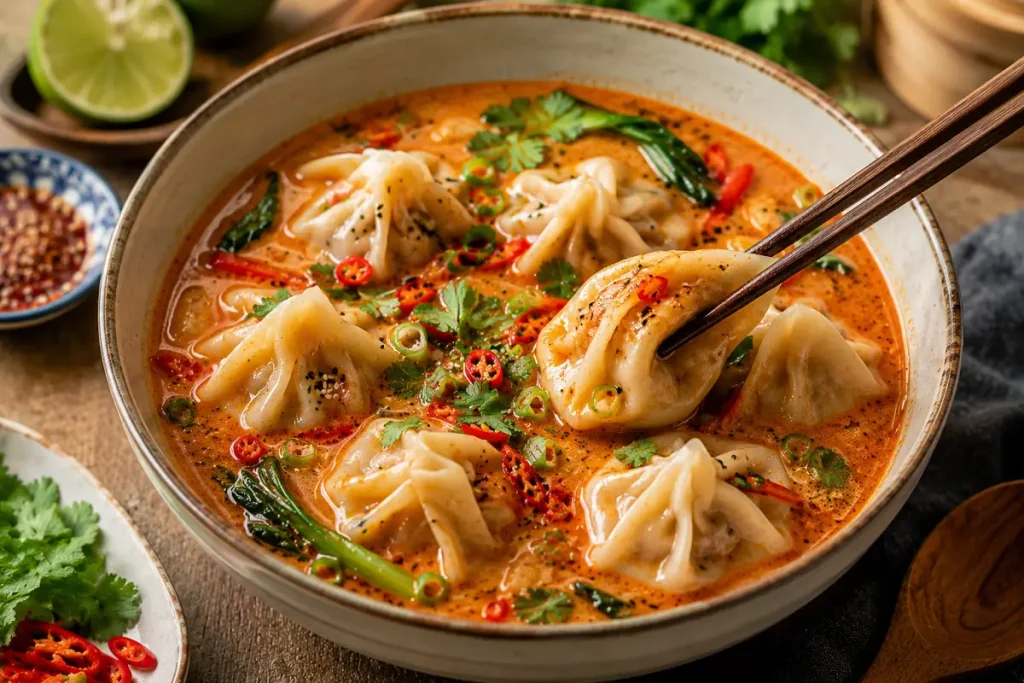
The full recipe with all ingredients and step-by-step directions is available below in the recipe card. Key shopping notes:
- Red curry paste: Maesri brand delivers the most complex, layered heat. Lobo runs slightly sweeter; Mae Ploy is mildest — good for heat-sensitive households.
- Coconut milk: Use full-fat Thai brands (Aroy-D or Chaokoh). Light coconut milk can prevent the jelly from setting properly.
- Gelatin: Knox unflavored gelatin works perfectly. Keep coconut milk to no more than 40% of total liquid volume for clean setting.
How to Make the Spicy Thai Red Curry Broth Jelly
This step is the heart of the recipe and must be done first. In 2025, Thai-inspired soups drove a 4.1% year-on-year expansion in Thailand’s foodservice sector, which reached €26.8 billion (Nation Thailand, 2025). That growth reflects how well Thai broth profiles translate into premium home cooking formats like these dumplings.
The key steps: build your curry broth base with stock and coconut milk, bloom the red curry paste until fragrant, season boldly (the gelatin mellows flavor), strain, bloom the gelatin, then refrigerate for at least 4 hours until set to a firm but jiggly consistency. Cut into ½-inch cubes before filling your dumplings.
Pro tip: If your kitchen is warm (above 75°F/24°C), chill the filled dumplings for 10 minutes before steaming to prevent the jelly from melting prematurely.
How to Fold and Steam Your Dumplings
The dumpling wrapper is where most home cooks hesitate — but the technique is simpler than it looks. The global dumplings market is growing at 12.2% CAGR (Business Research Company, 2026), partly driven by home cooks who discovered during the pandemic that handmade dumplings are meditative, not complicated.
Key technique points: rest your dough for a full 30 minutes (non-negotiable — relaxed gluten rolls dramatically easier), roll wrappers thinner at the edges than the center, and create 12–14 tight pleats that twist to a sealed top. Steam over a rolling boil for exactly 8 minutes without lifting the lid.
Serving Tips and Variations
Once your dumplings emerge from the steamer, serve them immediately. The correct eating method: transfer to a soup spoon, nibble a small hole in the top, add 3–4 drops of dipping sauce, and eat in one bite. The Thai cuisine market is projected to grow from USD 18.23 billion in 2025 to USD 27.28 billion by 2030 at a CAGR of 8.39% (Fortune Business Insights, 2025), driven by consumers who want restaurant-quality Thai flavors at home. This serving ritual is part of that experience.
Popular variations worth trying: vegetarian (shiitake + tofu filling), extra spicy (sambal oelek in the filling), green curry swap, or a 15-minute weeknight shortcut using store-bought frozen soup dumplings in a quick Thai red curry broth soup.
Common Mistakes to Avoid
- Broth jelly won’t set: Too much coconut milk (keep to ≤40% of liquid), or the gelatin wasn’t fully dissolved before chilling.
- Wrappers tear: Dough is too dry or under-rested. Add 10 more minutes of rest if cracks appear at the edges.
- Soup leaks during steaming: Over-filling is the usual culprit. Maximum: 1 tsp filling + 2 jelly cubes per wrapper.
- Dumplings stick: Always line your bamboo steamer with parchment paper or cabbage leaves.
The Recipe
 AuthorEmma food bloggerDifficultyAdvanced
A bold Thai-Chinese fusion: silky soup dumplings filled with spiced pork-and-shrimp and a coconut red curry broth jelly that floods every bite with fragrant heat.
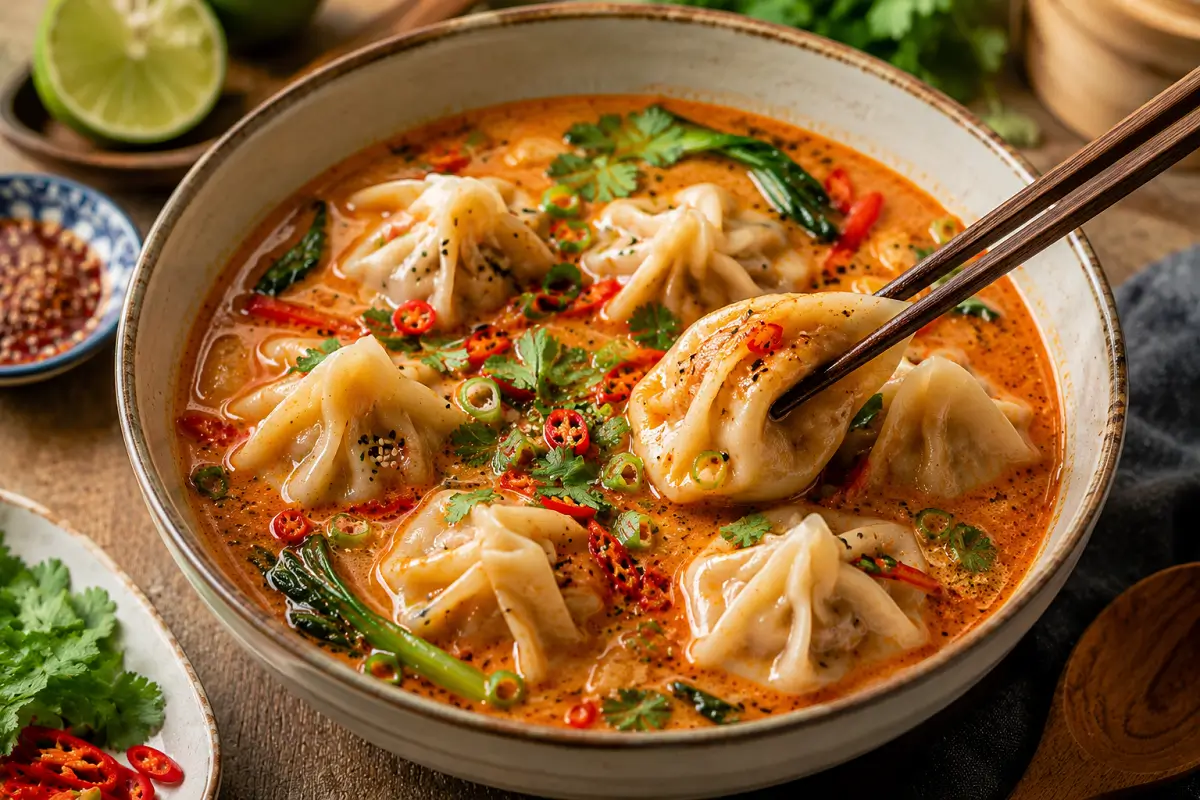
Pour chicken stock and coconut milk into a medium saucepan over medium heat. Add bruised lemongrass, galangal slices, and kaffir lime leaves. Heat until just barely simmering — do not boil or coconut milk will split.
Push aromatics to the side and add the red curry paste. Stir it in a cleared space for 60 seconds until fragrant and toasted, then stir into the stock.
Add fish sauce and palm sugar. Taste and adjust — the broth should be salty, mildly sweet, and boldly spicy. Strain through a fine-mesh sieve, discarding the solids.
Let broth cool to 130°F / 54°C. Sprinkle gelatin over 3 tablespoons of cold water in a small bowl; let bloom for 5 minutes. Whisk bloomed gelatin into the warm broth until completely dissolved.
Pour into a shallow container and refrigerate at least 4 hours or overnight until firm but jiggly. Cut into ½-inch cubes and return to fridge until needed.
Combine flour and salt in a large bowl. Add just-boiled water gradually, stirring with chopsticks until the dough forms shaggy clumps.
Turn out onto a lightly floured surface and knead for 8 minutes until smooth and elastic — texture should feel like an earlobe. Cover with a damp cloth and rest for 30 minutes.
Divide dough into 4 portions. Roll each into a ¾-inch-diameter rope and cut into ¾-inch pieces (about 30–32 total). Roll each piece into a 3½-inch circle, thinner at the edges than the center.
Combine all filling ingredients in a bowl. Mix vigorously with chopsticks in one direction only for 2 minutes to develop a springy protein network. Refrigerate 15 minutes.
Hold a wrapper in your non-dominant hand, cupped slightly. Place 1 teaspoon of filling in the center, then add 2 small cold broth jelly cubes on top. Do not overfill.
Fold the wrapper up around the filling and create 12–14 pleats along the edge, pinching firmly toward a central point. Twist the top gently to seal. Set on a parchment-lined plate.
Steam in a bamboo steamer over boiling water for exactly 8 minutes. Do not lift the lid during steaming — steam loss causes uneven cooking.
Whisk together black rice vinegar, lime juice, fish sauce, chili oil, julienned ginger, and toasted sesame seeds. Rest 5 minutes before serving so flavors marry.
Transfer dumplings from steamer to a soup spoon using chopsticks. Nibble a small hole in the top, add 3–4 drops of dipping sauce, and eat the whole dumpling in one bite. Slurp the broth first if it pools in the spoon.
6 servings
5 dumplings (approx. 120g)
- Amount per serving
- Calories285
- % Daily Value *
- Total Fat 14g18%
- Saturated Fat 6g30%
- Trans Fat 0g
- Monounsaturated Fat 5g
- Polyunsaturated Fat 2g
- Cholesterol 95mg32%
- Sodium 620mg27%
- Total Carbohydrate 28g11%
- Dietary Fiber 1g4%
- Total Sugars 3g
- Includes 1g Added Sugars2%
- Protein 13g
- Vitamin A 180mcg20%
- Vitamin C 4mg5%
- Calcium 45mg4%
- Iron 2mg12%
- Potassium 310mg7%
* The % Daily Value (DV) tells you how much a nutrient in a serving of food contributes to a daily diet. 2,000 calories a day is used for general nutrition advice.
Ingredients
Frequently Asked Questions
Can I make Thai red curry soup dumplings ahead of time?
Yes — the broth jelly keeps refrigerated for up to 3 days and frozen for 2 months. Filled but uncooked dumplings can be frozen flat on parchment, then stored in a zip-lock bag for up to 3 months. Steam directly from frozen, adding 3 extra minutes. Don’t refrigerate filled raw dumplings more than 2 hours as the jelly begins to melt.
What’s the best red curry paste brand for this recipe?
Maesri Thai Red Curry Paste delivers the most authentic depth — balanced heat with strong lemongrass-galangal presence. Avoid Indian-style red curry pastes, which use heavy cumin and coriander profiles that clash with the coconut-forward Thai broth. Lobo brand is a good mild-to-medium alternative widely available in Asian grocery stores.
How spicy are these dumplings?
With 3 tablespoons of Maesri red curry paste, these rate about 6 out of 10 on a home-cook heat scale — noticeably spicy but not overwhelming. The coconut milk moderates the heat significantly. For milder, reduce to 1½ tbsp. For more fire, add ½ tsp bird’s eye chili paste to the filling.
Is there a shortcut version using frozen dumplings?
Absolutely. Cook store-bought frozen pork xiao long bao per package directions, then serve in a hot Thai red curry broth (stock + coconut milk + red curry paste + lemongrass + fish sauce + lime, simmered 15 min). It’s not the same as the from-scratch version, but it’s a genuinely delicious 20-minute weeknight meal delivering 80% of the flavor with 20% of the effort.
Why is there no soup inside after steaming?
This almost always means jelly cubes were too large, too warm, or pressed against the wrapper seam instead of centered on the filling. Use cold ½-inch cubes straight from the fridge, center them on the meat filling, and fold immediately. If your kitchen is warm (above 75°F/24°C), chill filled dumplings for 10 minutes before steaming.
Sources
- Business Research Company — Dumplings Global Market Report 2026
- Fortune Business Insights — Thai Cuisine Market 2025
- Oxford Academic, IJFST — Nutraceutical Potential of Modified Thai Red Curry Paste, January 2025
- Nation Thailand — Thai Foodservice Market 2025
- USDA FAS — Thailand: A Taste of Tomorrow, 2025
- SoupAddict — Thai Red Curry Dumpling Soup
- Healthline — Is Thai Food Healthy?
- Savory Satay Beef Noodle Soup: A Flavorful Delight Awaiting!
- Beef Sinigang: What Makes It the World’s #1 Comfort Soup?