
Mussels are one of the most underrated proteins on your grocery list — they deliver 16 grams of protein per 100g cooked meat with an amino acid score of 107, surpassing eggs (Nutrients Journal via PMC, 2021). Yet most home cooks walk right past them at the seafood counter, convinced they’re difficult or fussy to prepare. They’re not.
In 2026, the global mussel market hit USD 3.9 billion and is growing at 5% annually (Future Market Insights, 2025) — a signal that cooks worldwide are finally catching on to what French bistros and Spanish tapas bars have known for decades. With a bag of live mussels, a knob of butter, three garlic cloves, and a lemon, you can have a stunning seafood dinner on the table in under 20 minutes.
This guide walks you through every step — from selecting live mussels at the market to plating a glossy, herb-flecked bowl you’d happily pay $30 for at a restaurant.
Key Takeaways
• Mussels deliver 16g of protein per 100g with an amino acid score of 107 — higher than eggs (Nutrients Journal, 2021).
• They steam fully open in just 4–6 minutes; any mussel that stays shut should be discarded per FDA food safety guidelines.
• Mussel farming produces only 0.6 kg CO2e per kg of edible protein — making this one of the most sustainable dinners you can cook.
• The full recipe takes under 20 minutes from prep to plate.
What Ingredients Do You Need for Lemon Garlic Butter Mussels?
In 2026, mussels are readily available fresh at most supermarkets, fish counters, and online seafood retailers year-round. Good preparation means you won’t be scrambling mid-cook.
Ingredients (serves 2 as a main, 4 as a starter):
- 1 kg (2.2 lbs) live mussels
- 4 tablespoons unsalted butter
- 5 garlic cloves, finely minced
- 125 ml (½ cup) dry white wine (or seafood stock for alcohol-free)
- Juice of 1 lemon + zest of half
- Small bunch of flat-leaf parsley, roughly chopped
- ½ teaspoon red pepper flakes (optional)
- Crusty bread to serve
Equipment:
- Large heavy pot or Dutch oven with a lid (at least 5-litre capacity)
- Sharp knife and cutting board
- Colander and kitchen brush
Estimated time: 20 minutes total (10 prep, 10 cook)
Difficulty: Beginner
Why Are Mussels Worth Cooking at Home?
In 2021, a peer-reviewed analysis published in Nutrients found that mussels contain 300–800 mg of long-chain omega-3 fatty acids (EPA + DHA) per 100g cooked meat, with 50–60% of those lipids being phospholipids — a form with especially high bioavailability (PMC8067026). A 2025 global population study spanning 1990–2021 linked diets low in seafood omega-3s to approximately 627,340 cardiovascular deaths per year worldwide (PMC12051498).
Mussels also contain roughly 20 µg of Vitamin B12 per 100g — approximately 20 times more than beef steak — along with 267.8 µg of iodine per 100g. And mussel farming generates only 0.6 kg of CO2 equivalent per kg of edible product, compared to 19.0–36.7 kg CO2e/kg for beef (PMC8067026, 2021).
Step 1: Select and Clean Your Mussels
By the end of this step, you’ll have a bowl of clean, live mussels ready for the pot. The FDA is clear: live mussels should be used within 2–3 days of purchase, and any mussel with a cracked shell or that doesn’t close when tapped should be discarded (FDA Seafood Safety).
- Tap each mussel. A live mussel will slowly close within 30 seconds. If it stays wide open, discard it.
- Discard cracked shells. Any structural damage means the mussel is compromised.
- Scrub the shells under cold running water with a stiff brush to remove grit and barnacles.
- Remove the beard. Grip the fibrous byssus thread and pull firmly toward the narrow end of the shell.
- Rinse and hold in cold water in the fridge until ready to cook.
Pro tip: Don’t soak mussels in fresh water for more than 20 minutes — it can stress or kill them.

Step 2: Build the Lemon Garlic Butter Base
By the end of this step, you’ll have a fragrant, glossy garlic butter sauce ready to receive the mussels.
- Heat the pot over medium heat for 60 seconds before adding butter.
- Melt 3 tablespoons of butter. It should foam gently, not spit aggressively.
- Add the garlic and cook for 60–90 seconds, stirring constantly. The garlic should turn translucent and fragrant, not golden. Once it starts colouring, it’s about to burn.
- Add pepper flakes (if using) and stir for 15 seconds.
- Pour in the white wine and bring to a simmer for 2 minutes.
- Add lemon zest and half the juice. Stir to combine.
Step 3: Steam the Mussels
By the end of this step, you’ll have a pot of fully opened, cooked mussels swimming in their own gorgeous broth.
- Add the drained mussels all at once to the pot.
- Put the lid on immediately and turn the heat to high.
- Cook for 4–6 minutes without lifting the lid. Steam is doing the work.
- Check at 4 minutes. If most shells are open, they’re done.
- Discard any closed mussels. Per FDA guidelines, do not try to pry them open.
- Add the remaining tablespoon of butter to the pot and swirl into the broth.
Step 4: Finish and Plate
- Squeeze remaining lemon juice over the pot. Taste and adjust salt.
- Add the chopped parsley and stir gently.
- Transfer to a wide shallow bowl, then ladle the broth over the top.
- Serve immediately with thick slices of crusty bread.
Garnish options: Extra parsley, olive oil drizzle, lemon wedge, fleur de sel.
What Nutrients Do Lemon Garlic Butter Mussels Contain?
A 300g serving of cooked mussels delivers approximately 48g of protein, 900–2,400 mg of EPA+DHA omega-3s, a full day’s worth of Vitamin B12 (60 µg vs. the 2.4 µg RDA), and substantial iodine — all in under 300 calories before the butter. According to the 2025 PMC population study, diets low in seafood omega-3s were linked to ~627,340 cardiovascular deaths annually worldwide (PMC12051498).
What Are the Most Common Mistakes When Cooking Mussels?
Most problems trace back to these four fixable mistakes:
1. Not discarding dead mussels before cooking — If it doesn’t close when tapped, discard it. Per FDA guidance, any raw mussel with a cracked shell or that stays open must go.
2. Cooking with the lid off — Every time you lift the lid, you drop the temperature and add 30–60 seconds. Leave it on for four minutes.
3. Burning the garlic — Garlic turns bitter in about 20 seconds at high heat. Use medium heat and stir constantly.
4. Skipping the butter finish — That final tablespoon of butter emulsifies into the broth, turning it from thin to glossy and rich. Don’t skip it.
What Are the Best Variations of This Mussel Recipe?
- Moules marinières: Increase wine to 200ml, add shallot and bay leaf, skip lemon zest.
- Tomato and chorizo mussels: Sauté chorizo with garlic, add cherry tomatoes, finish with smoked paprika.
- Thai coconut mussels: Replace wine with coconut milk, add red curry paste and lemongrass.
- Cream and cider mussels: Replace wine with dry cider, finish with double cream and tarragon.
Frequently Asked Questions
How do you know when mussels are cooked?
Mussels are fully cooked when their shells have opened wide, typically after 4–6 minutes over high heat in a covered pot. The meat inside should look plump and orange-yellow, not shrunken or grey. Discard any mussel that remains shut.
Can you eat mussels that don’t open after cooking?
No. A mussel that doesn’t open may have been dead before cooking or may have a damaged shell. FDA guidelines advise discarding all closed mussels — don’t try to pry them open.
How long do raw mussels keep in the fridge?
Live mussels should be cooked within 2–3 days of purchase, per FDA guidance. Store in the fridge in a mesh bag or open container with a damp cloth over them. Never store in a sealed bag or water.
What wine goes with lemon garlic butter mussels?
A dry, unoaked white wine works best — Muscadet, Picpoul de Pinet, Albarino, or Sauvignon Blanc. The same wine you cook with is usually ideal to drink alongside the dish.
Are mussels sustainable to eat?
Yes — mussel farming produces only 0.6 kg CO2e per kg of edible product (Nutrients Journal, 2021), compared to up to 36.7 kg CO2e/kg for beef. They filter nutrients from seawater and need no feed, fertiliser, or fresh water to farm.
Ready to Cook Perfect Lemon Garlic Butter Mussels?
You’ve now got everything you need: cleaned, inspected mussels, a fragrant garlic-lemon butter base, a proper steam, and the finishing-butter trick that separates a good bowl from a great one. The whole process takes 20 minutes.
Try the base recipe once, then riff: white wine and shallots, coconut and lemongrass, tomato and chorizo. The technique stays the same. Only the flavour changes.
Share your bowl in the comments — I’d love to see how yours turned out.
 AuthorEmma food bloggerDifficultyBeginner
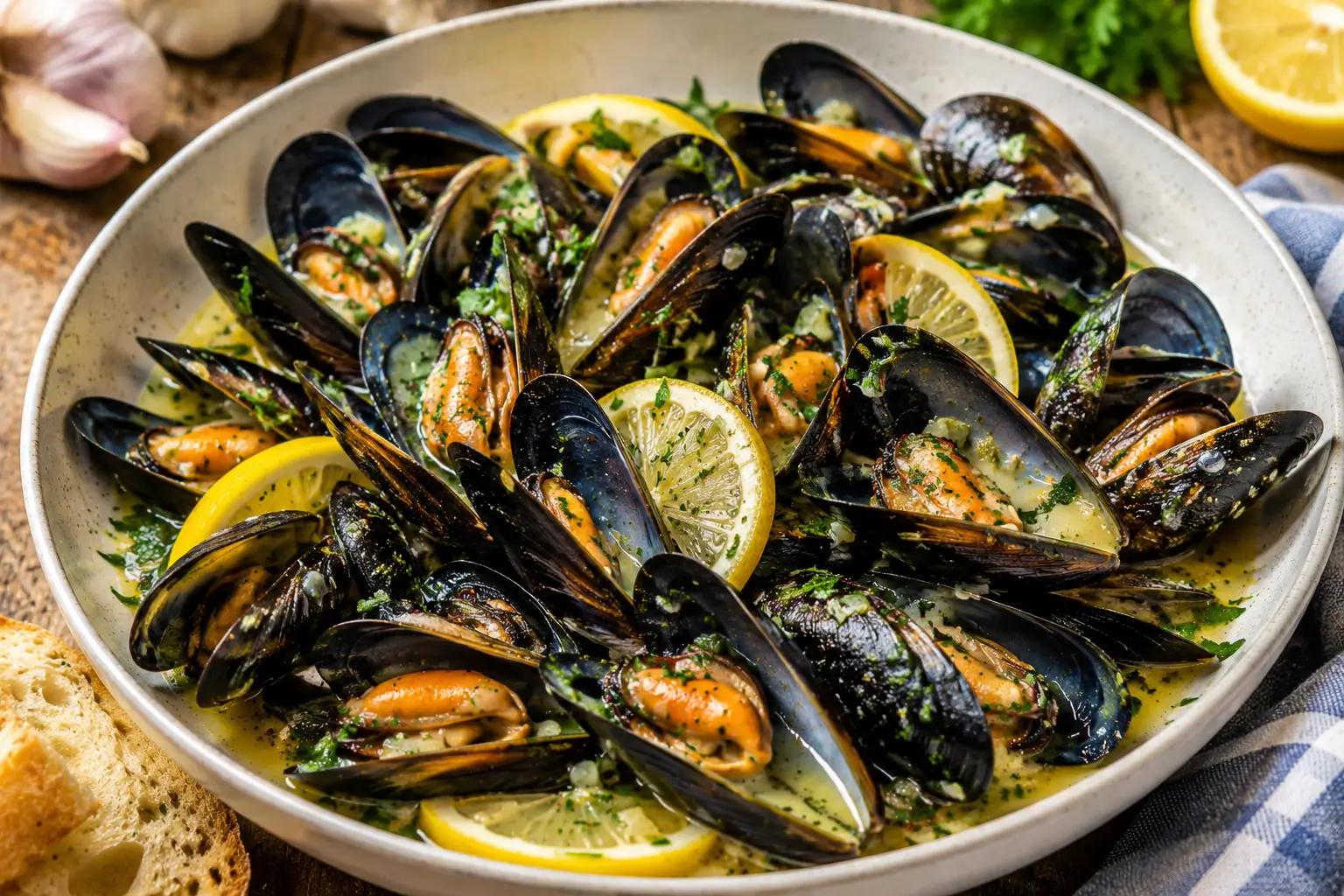
Restaurant-quality mussels steamed in a fragrant lemon garlic butter sauce with white wine. Ready in 20 minutes from a single pot.
Tap each mussel sharply on the counter. A live mussel will slowly close within 30 seconds. Discard any that stay open, have cracked shells, or smell off.
Scrub the shells under cold running water with a stiff brush. Remove the beard (byssus thread) by gripping it firmly and pulling toward the narrow end of the shell. Rinse clean and keep refrigerated until ready to cook.
Heat a large heavy pot or Dutch oven over medium heat. Add 3 tablespoons of butter and let it foam gently. Add the minced garlic and cook for 60-90 seconds, stirring constantly, until translucent and fragrant — do not let it brown or burn.
Add red pepper flakes (if using) and stir for 15 seconds. Pour in the white wine, bring to a simmer, and cook for 2 minutes to cook off the alcohol. Add the lemon zest and half the lemon juice; stir to combine.
Add all the drained mussels at once. Immediately put the lid on and turn the heat to high. Cook for 4-6 minutes without lifting the lid. At 4 minutes, check: most shells should be open. If not, replace the lid for one more minute.
Discard any mussels that have not opened — do not try to pry them open. Add the remaining tablespoon of butter to the pot and swirl it into the broth. Squeeze the remaining lemon juice over the top and taste for seasoning.
Scatter the chopped parsley over the mussels and stir gently. Transfer to wide shallow bowls and ladle the broth generously over the top. Serve immediately with thick slices of crusty bread for dipping.
2 servings
500g (approx. half the pot)
- Amount per serving
- Calories420
- % Daily Value *
- Total Fat 22g29%
- Saturated Fat 12g60%
- Trans Fat 0g
- Monounsaturated Fat 6g
- Polyunsaturated Fat 2g
- Cholesterol 120mg40%
- Sodium 920mg40%
- Total Carbohydrate 12g5%
- Dietary Fiber 0g
- Total Sugars 2g
- Protein 48g
- Vitamin C 25mg28%
- Calcium 60mg5%
- Iron 8mg45%
- Potassium 680mg15%
- Vitamin D 4mcg20%
- Iodine 267mcg178%
- Zinc 4mg37%
* The % Daily Value (DV) tells you how much a nutrient in a serving of food contributes to a daily diet. 2,000 calories a day is used for general nutrition advice.
Ingredients
Sources
- Fassett, R. et al. “Farmed Mussels: A Nutritive Protein Source, Rich in Omega-3 Fatty Acids, with a Low Environmental Footprint.” Nutrients, PMC8067026, 2021. https://pmc.ncbi.nlm.nih.gov/articles/PMC8067026/
- “Global Burden of Cardiovascular Diseases Attributable to Diet Low in Seafood Omega-3 Fatty Acids.” PMC12051498, 2025. https://pmc.ncbi.nlm.nih.gov/articles/PMC12051498/
- FDA. “Selecting and Serving Fresh and Frozen Seafood Safely.” https://www.fda.gov/food
- Future Market Insights. “Mussel Market Size, Trends & Forecast 2025–2035.” https://www.futuremarketinsights.com/reports/mussels-market
- Spicy Thai Red Curry Soup Dumplings: You’ll Love Every Bite!
- Beef Sinigang: What Makes It the World’s #1 Comfort Soup?